
How to Search Cases by Name
Utah Courts Xchange is the broad public case-history search for Daggett County district and justice matters. Names appear as filed, so punctuation, suffixes, middle names, and spelling can change results. A business belongs in the last-name or company field. Common names need more filters, such as jurisdiction, court location, case type, or date.
- Enter Xchange through its guest, one-time, or subscriber route and choose a name-based search.
- Enter the last name or company. Add the first name, and use the documented wildcard option when spelling may vary.
- Choose Daggett County, Manila District Court, or Daggett County Justice Court as appropriate. Add case type and date filters.
- Review the court, location, case number, filing date, and party role before opening the case history.
- If nothing matches, remove a middle name, widen the date, switch court location, or ask the local clerk to confirm the record.
| Field Label | Type | Required | Notes |
|---|---|---|---|
| Last Name/Company | Text | For name search | Use the filed spelling; company names go here |
| First Name | Text | No | Wildcard guidance is available in Xchange help |
| Jurisdiction/Location | Selector | No | Narrow to Daggett or the correct Manila court |
| Case Type | Selector | No | Separates criminal, civil, traffic, and other records |
| Date Range | Date fields | No | Can filter filing, disposition, or judgment dates |
Daggett County Xchange Case Search
Xchange offers more than a name box. Its official search help documents jurisdiction, search type, case number, party name, case type, search scope, birth date, citation number, citation location, and date panels. Results may be narrowed by county, court, type, and dates. The public result limit is 500, so a broad common-name query may need refinement.
The service is paid. Current official information lists guest or one-time credit, per-search charges, and a monthly option. Fees and registration language can change, so read the current Xchange terms before searching. JavaScript, registration, and payment may be required. No official uptime promise appears in the researched material.
Search tip: “No case found” can mean a wrong court, spelling variation, date limit, filing lag, older paper record, or nonpublic classification. It does not prove that no case exists.
How to Search by Case Number
A case number is usually the strongest Daggett County lookup key. Enter it exactly as shown on a notice, filing, receipt, or calendar entry. Utah’s Xchange help uses a generic traffic example shaped like 085502036, but the research does not establish one universal Daggett format for all court levels and case types. Do not invent dashes, year codes, or prefixes.
Also choose the court location. The local CORE/CORIS payment interface warns that numbers are unique only within a court location. A matching number under the wrong venue may describe a different file. Xchange supplies the broader case-history route. The Daggett CORE portal accepts an exact citation or court case number but is a limited payment lookup, not a general public docket search.
For a number that fails online, call Justice Court at 435-784-3216 or the County Clerk at 435-784-3154. Provide the exact number, party name, likely case type, and date range. Older Manila material may need clerk research because public Xchange coverage begins April 7, 2000.
Daggett County Case Search Tools
Daggett County has no county-hosted full public docket database. Four official or officially linked tools handle different tasks. Xchange searches public case history. MyCase is free for eligible parties. Court Calendar lists scheduled events. CORE searches an exact citation or case number for payment-related information.
- Case history
- The chronological index of proceedings, filings, and dispositions in Xchange.
- Calendar event
- A future or scheduled activity, not proof that it occurred.
- Document
- A filed pleading, order, or other image that may require separate purchase or request.
- Disposition
- The recorded resolution of a charge, claim, or case stage.
Choosing the wrong tool creates false negatives. A citation may not yet be filed, and CORE also says a no-result response can mean no money is due. A calendar search can reveal a hearing but not all filings. MyCase cannot be used as open anonymous search. Match the tool to the task before drawing any conclusion.
What a Case Search Shows
A Daggett County Xchange result starts with identity and location fields. Opening the case number can reveal summary and extended history, proceedings, charge or claim information, disposition fields, assigned judge, party roles, attorneys, and document-purchase links when public images exist. The fields vary by court and case type.
| Case Number | The court’s identifier; pair it with the court location. |
|---|---|
| Parties | Names and role codes as indexed, subject to privacy rules. |
| Case Type | The category, such as criminal, civil, traffic, probate, or domestic. |
| Filed Date | The date the case entered the court system, not the incident date. |
| Status | Open, closed, disposed, or another system label that needs its date and context. |
| Proceedings | Chronological hearings or actions recorded in the history. |
A visible history does not guarantee that each pleading is public or downloadable. “Document available” can lead to a separate purchase. An account balance is not the same as a judgment. Likewise, a pending charge is not a conviction. Read the official disposition label and date.
Daggett County Case Records
When a case search locates the file but not the needed order, use the Utah court-record request process. The form asks for a reasonably specific description, court location, case number, record type, date range, contact details, and whether the requester wants inspection or copies. Utah Courts says an ordinary response may take up to ten business days.
The official request source shows the workflow that sits behind a Daggett County index result.
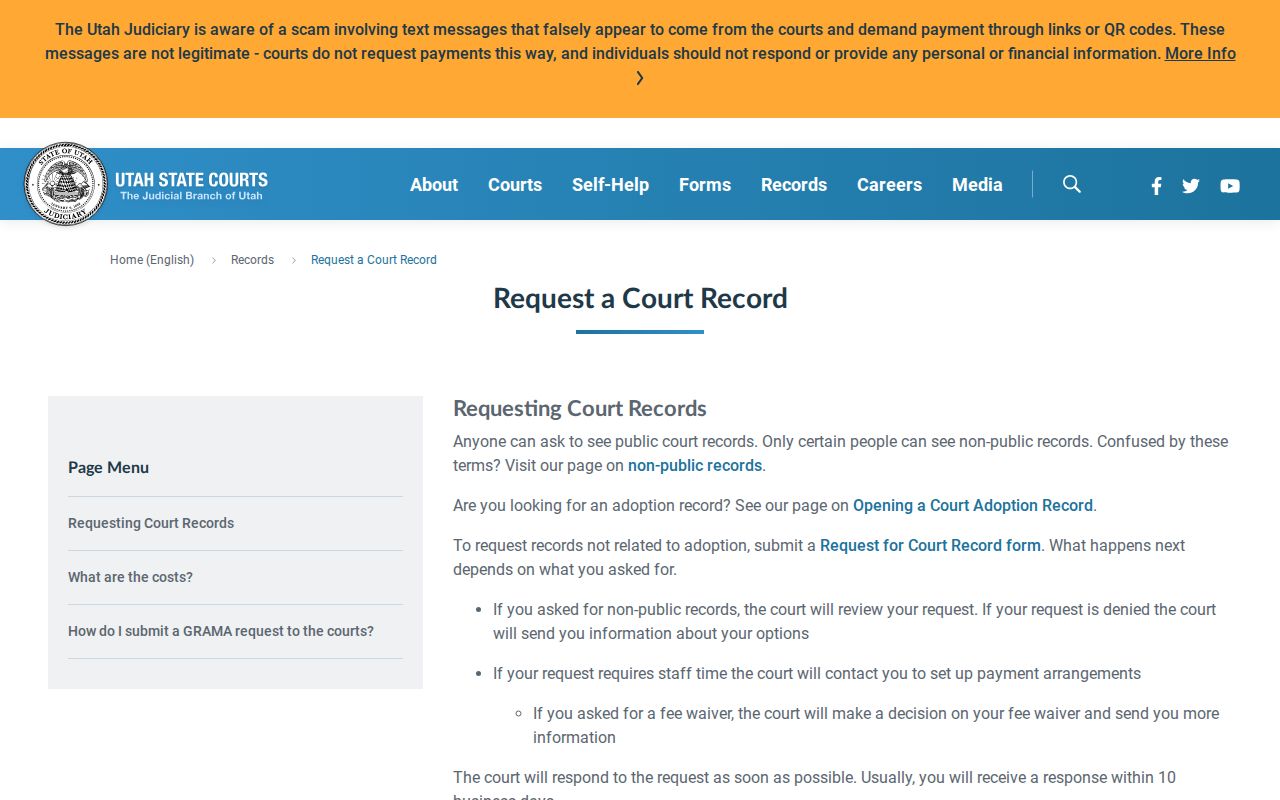
That request route is for judicial records. Daggett County’s GRAMA and NextRequest channels concern county administrative records and should not be treated as a way around court classifications.
County vs Statewide Case Search
Daggett County does not publish a separate full county case-search portal. The practical comparison is between statewide systems and local verification channels. Xchange covers indexed district and justice case history. The calendar covers settings. The local clerk and Justice Court handle confirmation, older files, and requests. CORE is local but narrow.
| Statewide layer | Daggett County layer |
|---|---|
| Xchange searches public indexed case history | Clerk confirms venue, older files, and record requests |
| MyCase serves verified eligible parties | Justice Court answers local date and citation questions |
| Court Calendar searches settings by case, party, judge, or attorney | CORE searches exact citation or case number for payment context |
In person, ask whether the Manila location has a public CORIS terminal. Utah Courts says most district courthouses and the State Law Library offer free terminals, but local availability should be confirmed before travel. Official pages also differ between “95 North 1st West” and “95 North 100 West,” so call before visiting.
Daggett County MyCase Access
MyCase gives eligible parties free access to their own Utah case history, filed papers, financial information, and supported eDocument tools. Account creation requires an email address, case number, government identification, and verification. Newer guidance also identifies access for qualifying criminal victims.
MyCase is not the public equivalent of Xchange. Some case categories remain unavailable, and private matters require proper authorization. Use it for a case in which the user has verified access. Public researchers should stay with Xchange, the calendar, and record requests. If MyCase cannot link a known case, contact the court rather than creating repeated accounts or changing identity details.
Restricted Cases and Access Rules
Utah court records are classified as public, private, protected, or sealed under UCJA Rule 4-202.02. A public case history can coexist with private pleadings or attachments. Utah Courts lists examples involving domestic, guardianship, custody, medical, victim, and fee-waiver material. Juvenile social and legal records are generally nonpublic. Adoption and expungement records may be sealed.
Do not try to bypass a classification through name variations, county GRAMA, or third-party copies. An authorized requester can submit the court-record form, explain the basis for access, and attach documentation. The court decides access under Rule 4-202.03. A missing public result may mean the case is restricted, but it can also reflect spelling, location, date, filing delay, or old coverage.
Note: “Private,” “protected,” and “sealed” are access classifications, not statements about the merits.
Daggett County Certified Case Records
A screen view or purchased Xchange image is not automatically a certified copy. Certification is the clerk’s authentication of a record. An exemplified copy carries additional formal authentication. Ask the responsible Daggett County clerk which form is needed before ordering.
The official Utah Courts fee page shows the certified and exemplified copy categories.
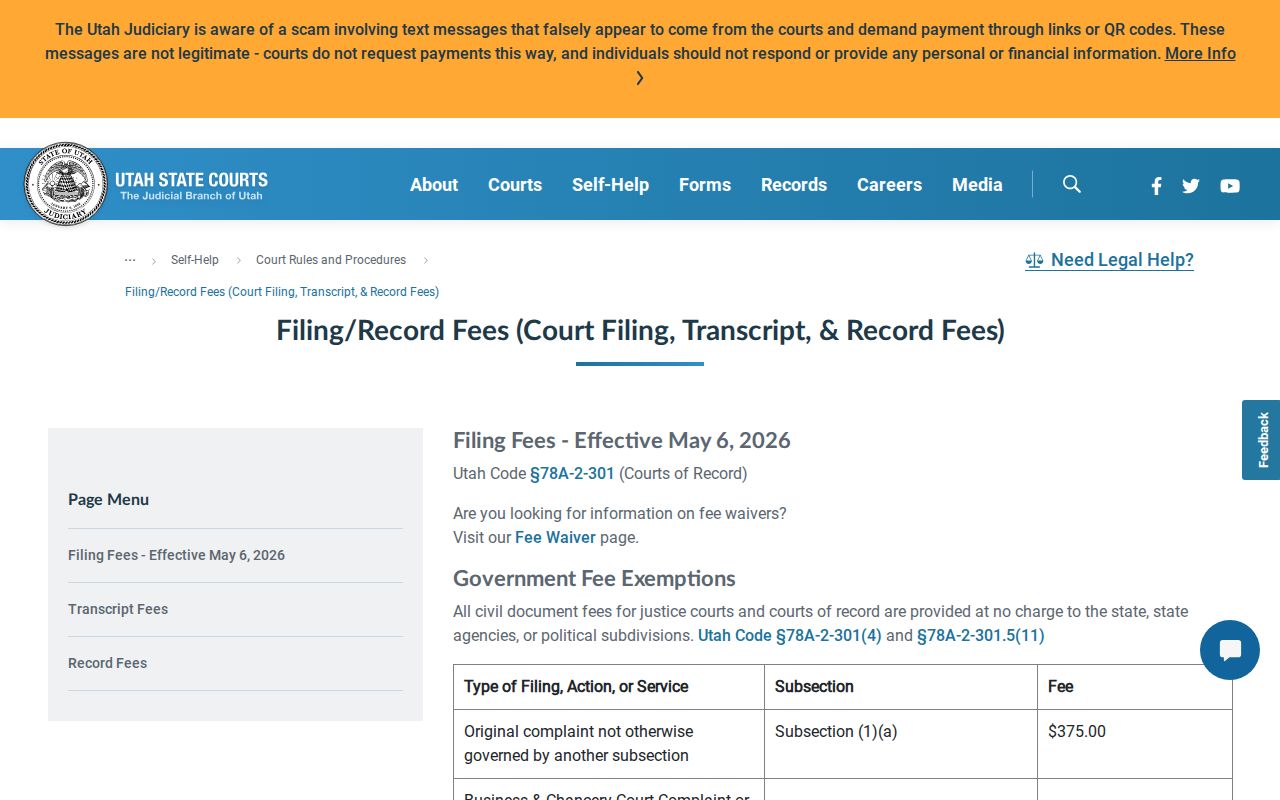
Current state guidance lists a certified copy at $4 per document plus $0.50 per page and an exemplified copy at $6 per document plus $0.50 per page. Fees can change. Confirm the schedule and delivery cost with the originating court before paying.